Tuesday, April 29, 2025

4 Tips on How you can Monitor a Life Insurance Policy loan


Life insurance policy loans can be a great option for policyholders who need quick access to cash. However, it’s important to remember that a policy loan is a loan and will have to be paid back with interest. As a policyholder, it’s essential to understand the ins and outs of taking out a policy loan and how to monitor it.

Here are four tips to help you monitor your life insurance policy loan:

1. Keep track of your loan balance and interest rate

It’s essential to keep track of your loan balance and interest rate. This will help you understand how much you owe and how much interest is accruing on the loan. You can monitor this information by reviewing your policy statement or contacting your insurance company directly. By keeping track of this information, you can ensure that you’re making timely payments and not falling behind on your loan.

2. Set up automatic payments

One of the best ways to ensure that you’re making timely payments on your policy loan is to set up automatic payments. This way, you won’t have to worry about missing a payment or falling behind on your loan. You can usually set up automatic payments through your insurance company’s website or by contacting their customer service department.

Read More...

Taking out a life insurance policy loan can be a great option for policyholders who need quick access to cash. However, it’s important to monitor the loan balance and interest rate, set up automatic payments, understand the impact of missed payments, and consider the impact on your death benefit. By following these tips, you can ensure that you’re making informed decisions about your policy loan and that you’re taking the necessary steps to monitor it.

For more Information, contact Tillman Insurance Advisors.

Thursday, April 24, 2025

Types of LIfe Insurance


When it comes to life insurance, there are several types to choose from, each with its own unique features and benefits. Understanding the different types of life insurance can help you choose the policy that best suits your needs and budget.

Here are the most common types of life insurance:

1. Term Life Insurance

Term life insurance is the most basic type of life insurance. It provides coverage for a set period of time, typically 10, 20, or 30 years. If the policyholder dies during the term of the policy, the beneficiaries receive a death benefit. Term life insurance is generally the most affordable type of life insurance and is a good choice for those who need coverage for a specific period, such as to pay off a mortgage or to provide for children until they reach adulthood.

2. Whole Life Insurance

Whole life insurance is a type of permanent life insurance that provides coverage for the entire lifetime of the policyholder. It includes both a death benefit and a cash value component, which grows over time and can be borrowed against or used to pay premiums. Whole life insurance is typically more expensive than term life insurance but provides lifelong coverage and can be a good choice for those who want to leave a legacy or have a lifelong financial obligation.

Read More...

Whether you need coverage for a specific period or want lifelong protection, there is a type of life insurance that can meet your needs. It is important to speak with our insurance agent to determine which type of life insurance is best for you, contact us at Tillman Insurance Advisors.

Monday, April 14, 2025

Benefits of Guaranteed issue life insurance


Group life insurance is a type of life insurance policy that is purchased by an organization or employer and provides coverage to a group of people, typically employees. While individual life insurance policies offer a range of benefits, group life insurance policies also offer some unique advantages. Here are five benefits of group life insurance:

1. No medical exam required

One of the biggest benefits of group life insurance is that it often does not require a medical exam. This can be especially beneficial for individuals with pre-existing medical conditions who may have trouble obtaining individual life insurance coverage. Additionally, it can simplify the enrollment process and make it easier for employees to obtain coverage.

2. Lower cost

Group life insurance policies are often less expensive than individual policies, since the cost of the policy is spread out among a larger group of people. This can be especially helpful for smaller businesses or organizations that may not have the resources to provide individual life insurance policies for their employees.

Read more...

If you are an employer or part of a group that is considering group life insurance, be sure to carefully consider your options, contact Tillman Insurance Advisors.

Tuesday, April 8, 2025

4 Things you Should Understand about Veteran Life Insurance Policy


Veteran life insurance policies are designed to provide financial protection to service members
and their families. These policies come in various types and have different terms and
conditions. It is important to understand what these policies entail before opting for one. In this
blog post, we will discuss the four things you should know about veteran life insurance policies.

1. Types of Veteran Life Insurance Policies:-

There are two main types of veteran life insurance policies: Service members’ Group Life
Insurance (SGLI) and Veterans’ Group Life Insurance (VGLI). SGLI is a life insurance policy
offered to active duty members, members of the Selected Reserve, and National Guard
members. VGLI is a life insurance policy available to those who are no longer on active duty but
who were insured under SGLI.

2. Coverage Amount:-

The amount of coverage available under SGLI is limited to $400,000. The amount of coverage
available under VGLI is based on the amount of coverage the service member had under SGLI,
up to a maximum of $400,000. The coverage amount for both policies may be less than
$400,000 depending on the service member’s situation.

Read more here...

If you need veteran life insurance policies, contact Tillman Insurance Advisors.

Wednesday, April 2, 2025

5 benefits of Simplified issue life insurance


Simplified issue life insurance is a type of life insurance that offers coverage without requiring a medical exam or extensive underwriting. This type of insurance can be a good option for those
who are looking for coverage without the hassle of a medical exam. Here are five benefits of
Simplified issue life insurance:

1. Easy application process
One of the most significant benefits of Simplified issue life insurance is the application process.
Unlike traditional life insurance policies that require a medical exam and extensive
underwriting, Simplified issue life insurance typically only requires basic health information. The application process is straightforward, and policies can often be issued quickly.

2. No medical exams
Another significant benefit of Simplified issue life insurance is the absence of a medical exam.
This can be especially appealing to those who have a fear of medical procedures or have a preexisting medical condition that could affect their ability to obtain coverage. With Simplified
issue life insurance, you can secure coverage without the stress or inconvenience of a medical
exam.

Read more here...

If you need life insurance without any hassle, contact Tillman Insurance Advisors.

Tuesday, February 18, 2025

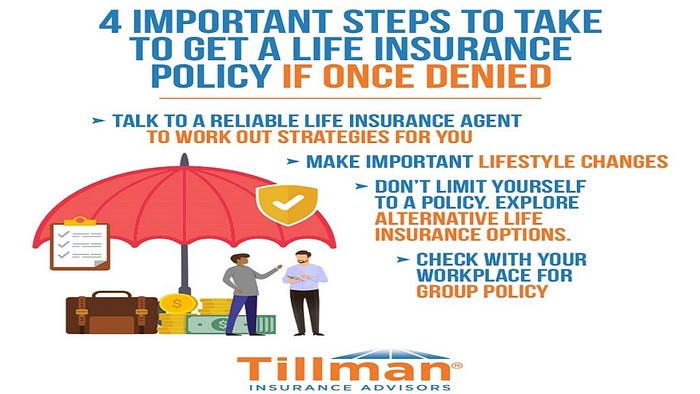
4 important steps to take to get a life insurance policy if once denied


Life insurance is an important investment for many people, as it can provide financial security for loved ones in the event of an unexpected death. However, if you have been denied coverage in the past, it can be discouraging and may make you feel like obtaining a policy is out of reach. The good news is that there are steps you can take to increase your chances of getting a life insurance policy, even if you have been denied in the past.

Here are four important steps to take:

  1. Determine why you were denied coverage:
    The first step is to understand why you were denied coverage. The reason for the denial can vary depending on the insurer, but common reasons include health issues, lifestyle choices (such as smoking or risky hobbies), or a poor driving record. Once you understand the reason for the denial, you can take steps to address the issue before reapplying.
  2. Address the reason for the denial:
    If you were denied coverage due to health issues, you may need to take steps to improve your health before reapplying. This could include losing weight, quitting smoking, or managing a chronic condition. If the denial was due to lifestyle choices, such as engaging in risky hobbies or having a poor driving record, you may need to change your behavior or take steps to reduce risk.
  3. Shop around:
    Different insurers have different underwriting guidelines and may be more willing to offer coverage to individuals with certain health conditions or lifestyle choices. Shopping around and getting quotes from multiple insurers can help increase your chances of finding a policy that fits your needs.
  4. Work with an independent insurance agent:
    An independent insurance agent can help you navigate the application process and find an insurer that is willing to offer coverage. They have access to a variety of insurers and can help you find the best policy for your needs.

In summary, being denied coverage for life insurance can be discouraging, but it’s important to remember that there are steps you can take to increase your chances of obtaining a policy. Understanding the reason for the denial, addressing the issue, shopping around, and working with an independent insurance agent can all help you find a policy that fits your needs. Don’t give up on obtaining life insurance coverage — take these important steps to increase your chances of success.

Wednesday, January 29, 2025

5 Reasons you Need Life Insurance if you’re self-employed


As a self-employed individual, you are your own boss and responsible for your own financial well-being. With the freedom of being self-employed, comes the responsibility of taking care of your financial future, and life insurance can help you do just that. Here are five reasons why you need life insurance if you’re self-employed:

  1. To cover business debts:
    As a self-employed individual, you may have taken on business debts to fund your venture. If something were to happen to you, your business debts could become the responsibility of your family. Life insurance can help cover these debts, so your family doesn’t have to worry about them.
  2. To replace lost income:
    If something were to happen to you, your family would lose your income. Life insurance can help replace that lost income, so your family can continue to pay the bills and maintain their standard of living.
  3. To fund buy-sell agreements:
    If you are in business with a partner, you may have a buy-sell agreement in place. Life insurance can be used to fund this agreement, so your partner can buy out your share of the business in the event of your death.
  4. To cover final expenses:
    Funerals can be expensive, and without life insurance, your family may struggle to pay for your final expenses. Life insurance can help cover these expenses, so your family doesn’t have to worry about the financial burden of a funeral.
  5. To leave a legacy:
    Life insurance can be used as an inheritance for your loved ones or to fund a charitable cause you care about. It can be a way to leave a legacy behind after you’re gone.

In conclusion, as a self-employed individual, life insurance is an important tool to help protect your financial future and ensure that your loved ones are taken care of in the event of your passing. It can cover business debts, replace lost income, fund buy-sell agreements, cover final expenses, and leave a legacy. So, if you’re self-employed, it’s important to consider purchasing life insurance to protect your family’s financial future.

Is AI Making Insurance Cheaper or More Expensive? Here’s What to Know

  As Artificial Intelligence (AI) continues to reshape the insurance industry, many people are asking the same question: Is AI helping l...